Illustration with Black and White Hatching
A course by JORGE LEWISGraphic artist
A course by JORGE LEWIS, Graphic artist

Learn to draw detailed hatching and create truly powerful images
Manual drawing is a fascinating process of great wealth, and exploring its limits, but above all, its wide possibilities through the use of mixed techniques, is what graphic artist Jorge Lewis wants to achieve with a clear objective: to create powerful images based on black and white Jorge creates and expresses stories with his drawings, for 18 years. His work is exhibited inside and outside Colombia, his country. In addition, he publishes his own books and produces serial editions of fine art and other products, that personal style.
In this course, Jorge will teach you to realize your full potential through manual drawing and some mixed techniques. You will carry out sketching processes starting from black and white, and you will learn to make patterns and textures using different materials such as stylographs and markers for the realization of powerful images digitally finished.
What will you learn in this online course?
20 lessons & 26 downloads
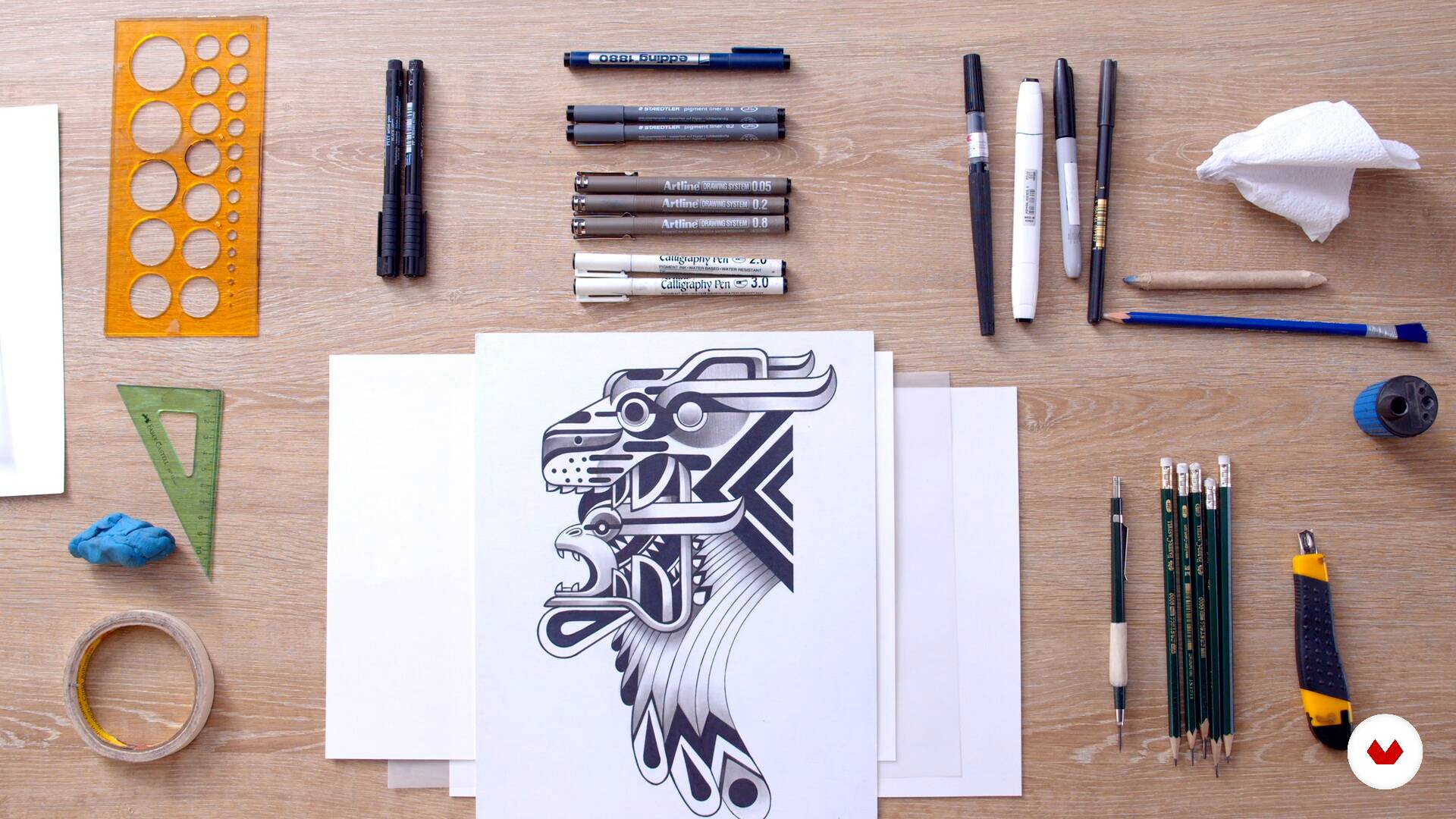
Presentation of materials
19 minutes, 41 seconds
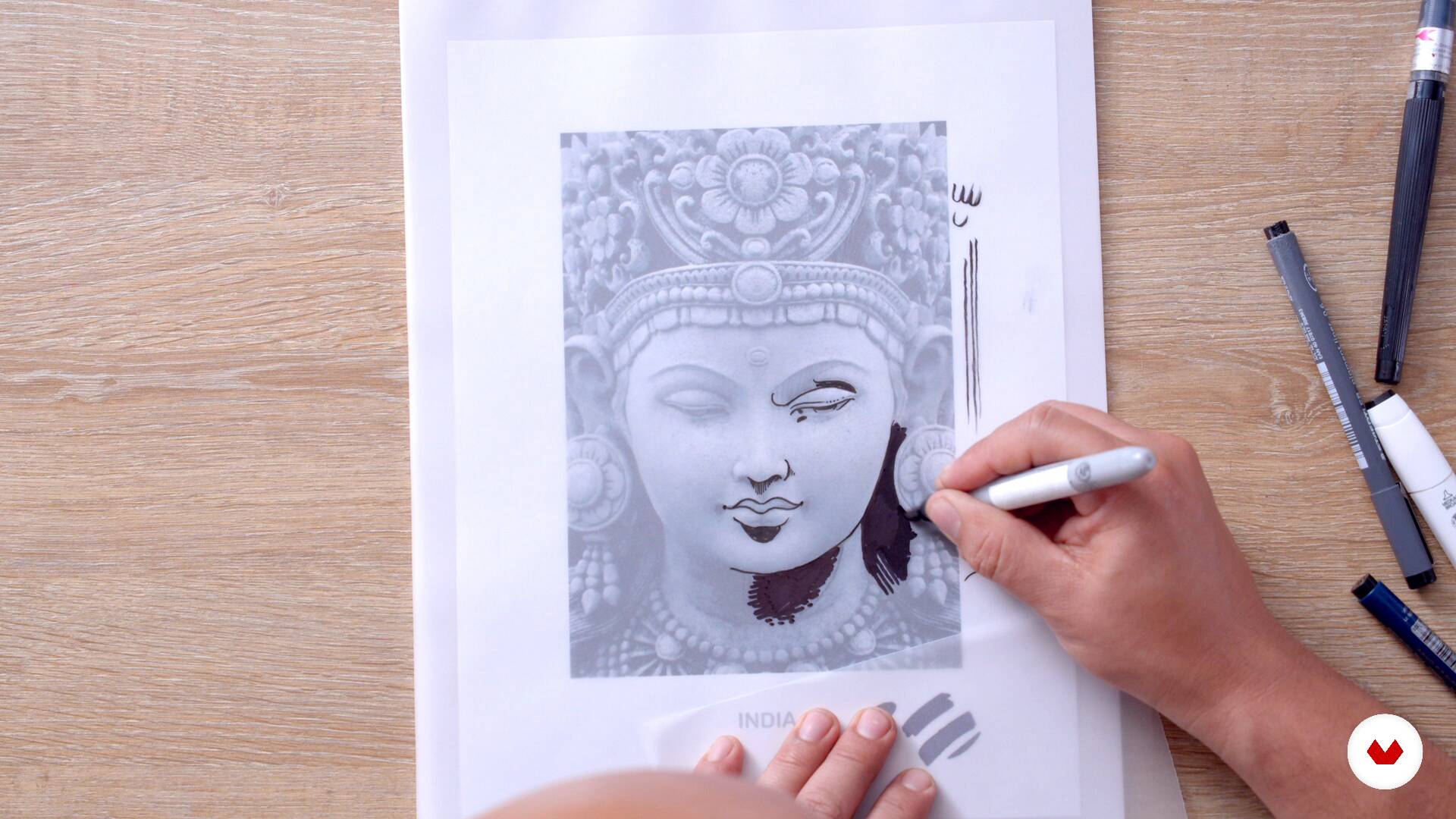
Inked in high contrast, black and white blocks
12 minutes, 32 seconds
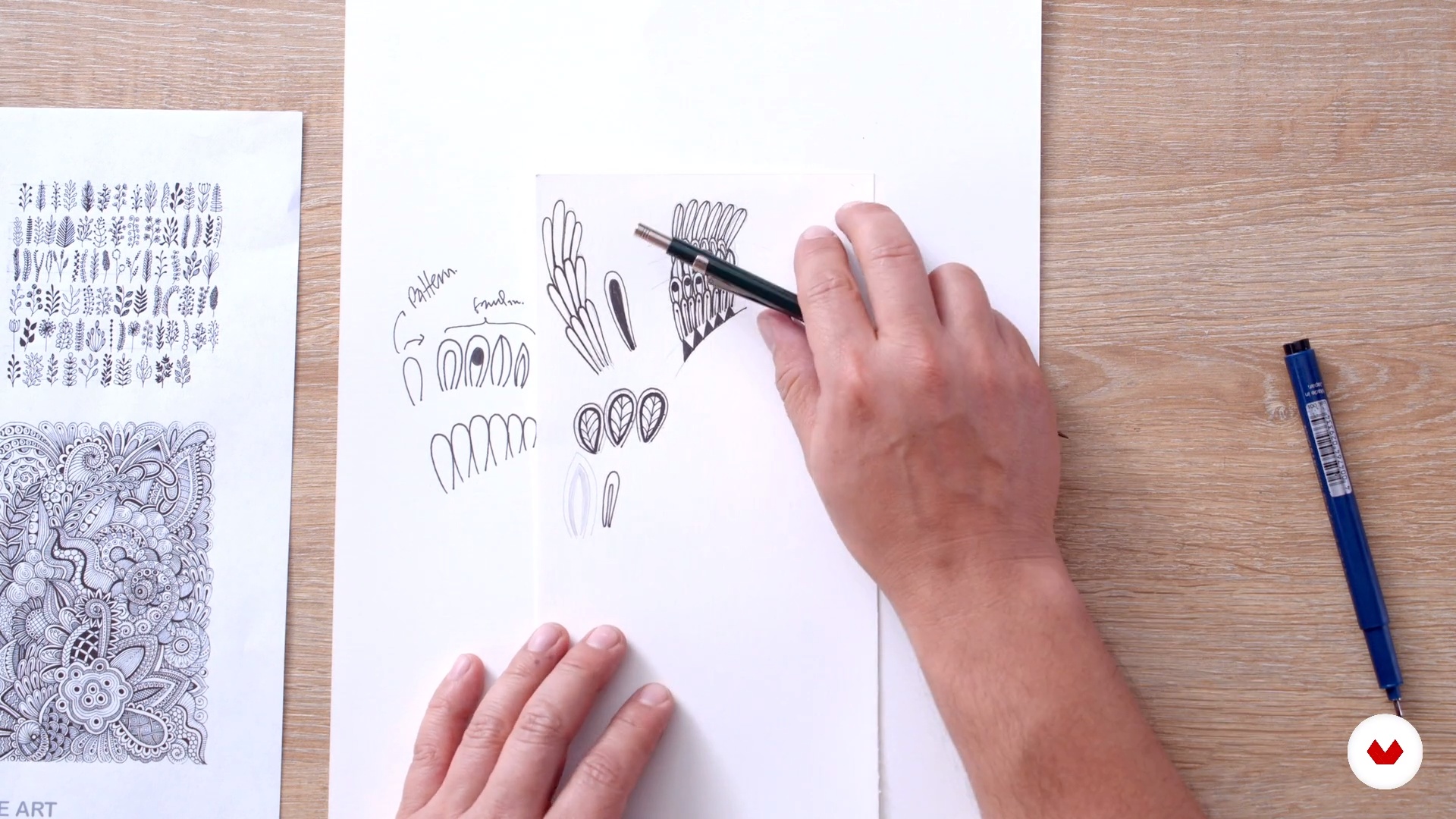
Design of ornaments, patterns and / or geometric repeating modules I
8 minutes, 31 seconds
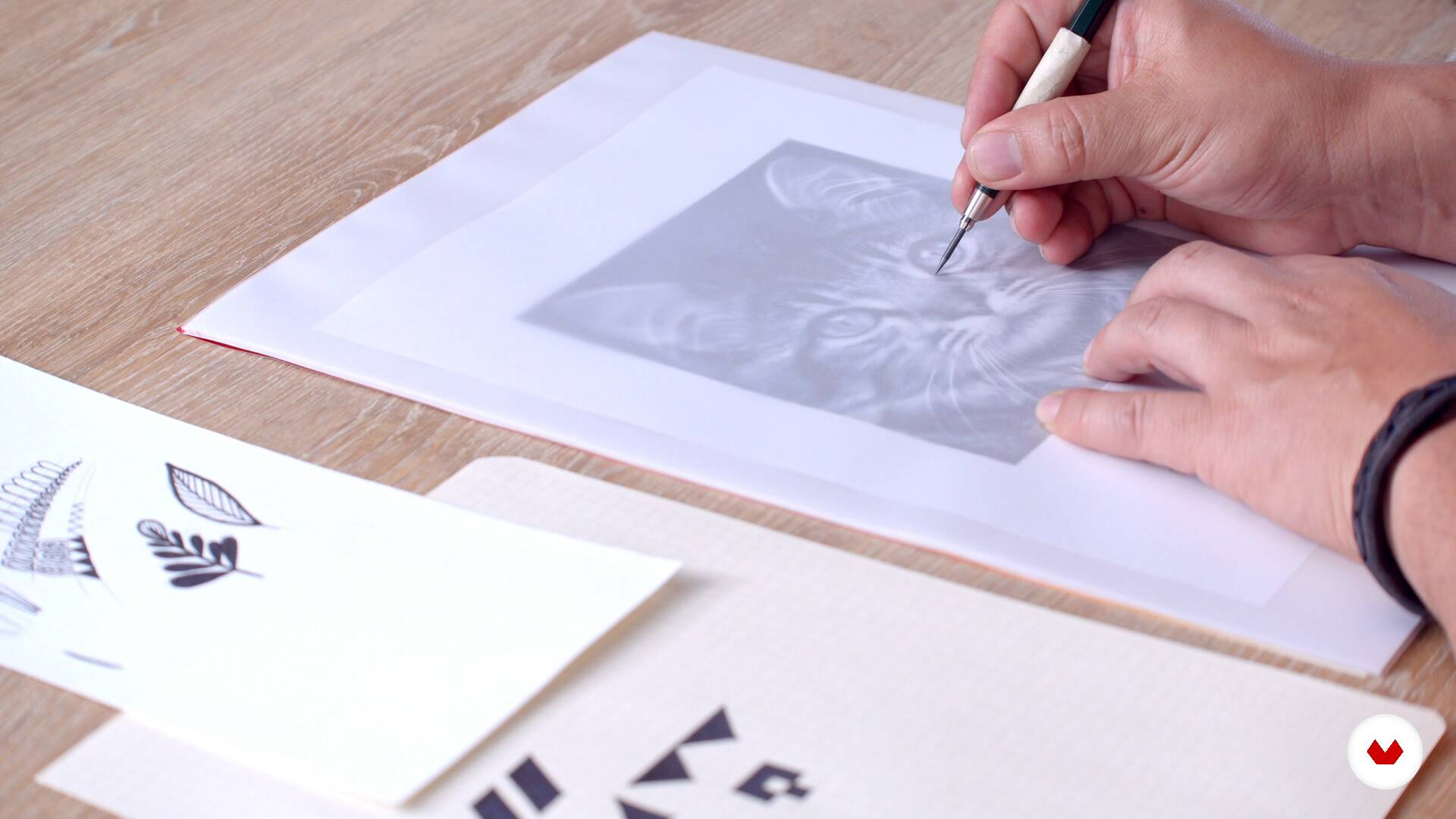
Design of ornaments, patterns and / or geometric repeating modules II
8 minutes, 40 seconds

Collage and drawing I
17 minutes, 26 seconds
Collage and drawing II
13 minutes, 57 seconds
What's included in this course?
You will meet Jorge Lewis, who will explain more about his career, his style and the influences that have motivated his work. It will tell you about creative processes that start from analog expressions and manual inking, and will teach you several possibilities to work with manual hatches and inks.
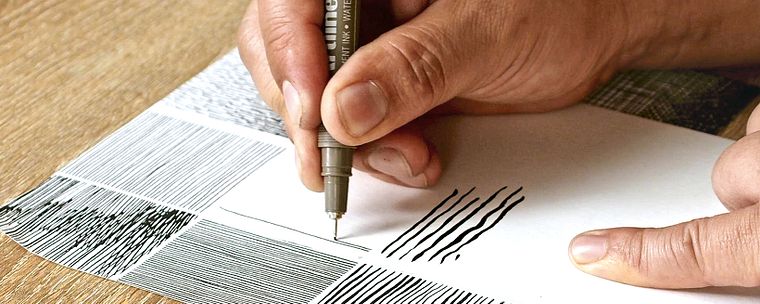
You will learn to create different patterns (short, long, cross, organic or scribble, prologue and patchwork), strokes and textures in inks; In addition to gradations, lighting and volumetry. You will practice with simple spherical, ovoid, cylindrical and conical shapes, determining illuminated and dark areas, and looking for three-dimensionality through the screen.
You will explore the black and white inks or blocks, the importance of line value and merge organic and geometric graphic gestures with stylographs and markers, to create patterns and integrate them into images.
You will practice from traces of photographs of animals and humans related to your final project of creating an anthropomorphic totem, studying light, volume and graphic synthesis.
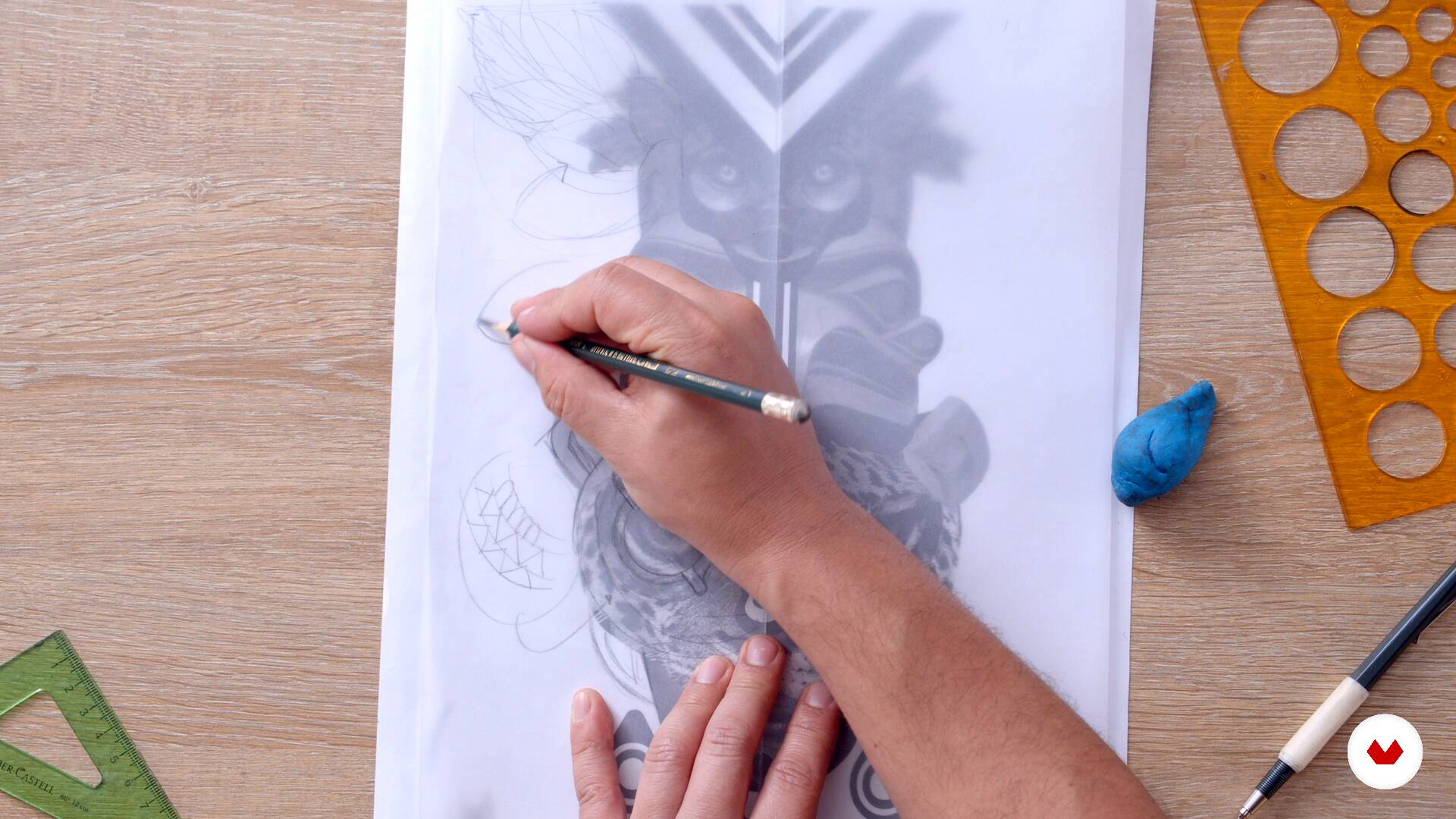
You will start building your image from the fusion between realism and geometry. You will start from the collection of visual information and a sketching process by using a manual collage.
Already with your template or collage, and using tracing as a technique, you will approach the final art of your drawing with analogs in an analogical way. Jorge will teach you special finishes and effects, deepening the shading with HB, H or 2H light pencils to reinforce the volume, contrast and dark sectors.
Finally you will perform the scanning of your analog drawing to finish editing it subtly in digital, and giving the color finishes to your work. You will finish your illustration for possible applications.
Recommended software & tools for this course
What is this course's project?
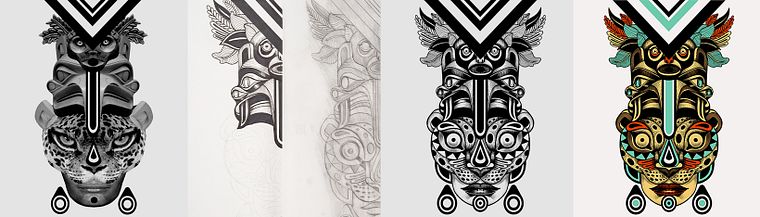
You will make the illustration of an anthropomorphic design, as a totem, which will start from an analog drawing made with ink; you will use or merge freely the geometries and ornaments and then apply digitally, subtle color finishes.
Projects by course students


Who is this online course for?
To empirical artists, professionals, illustrators, students of careers related to drawing, or anyone who has basic notions of representative drawing and wants to enrich their graphic repertoire and creative possibilities.
Requirements and materials
It is recommended to have basic knowledge of drawing and also of Adobe Photoshop. Of materials, you will need stylists of various calibers or line qualities - a 0.5, 0.1, 0.3, 0.5 and 0.8 are recommended - also stylus with a brush tip, 3 brushes finished in a fine point in 3 sizes - the smallest you can type 0.0– and two other flat brushes for filling - size according to your project–. Acrylic bristle brushes - a small type # 1 and # 5 -, pencils - Faber Castell or Staedtler 4H, H and HB -, medium and thick / beveled stylus Sharpie brand. Butter paper or 90 gram translucent tracing and tracing paper, inking paper of not less than 250 grams in A4 or A3 formats. You will need a computer with Adobe Photoshop and preferably a Wacom tablet for digital color.
Reviews
- 3 months ago
Me encantó mucho el cuerso
- luna14PLUS5 months ago
Por ahora hora muy bien, muy detallado.
- nancy_leblancPLUS1 year ago
Tout le procéder et bien expliqué
- 2 years ago
Super detallado
- 2 years ago
Excelente curso

He studied at the Superior School of Arts of Bogotá, is a master of Plastic Arts at the University of La Sabana, is a specialist in Media and Technologies for Pictorial Production by the National University Institute of Art of Buenos Aires, and studied a Master in Design and Illustration at the Polytechnic University of Valencia.
Today, he dedicates 100x100 to his personal work, continues to paint and draw his own subjects and be part of exhibitions and calls in galleries inside and outside the country, he publishes his own books and loves engraving and screen printing; it produces serial editions of fine art and derivative products, such as t-shirts, clothing and even stikers .
Content
- U1
Introduction
- Presentation (Who I am)
- Influences
- What will we do in the course
- U2
Lattice materials and techniques
- Presentation of materials
- Screening classes I
- Screening classes II
- Volume with frames
- Inked in high contrast, black and white blocks
- Imitating textured surfaces (inking and weft)
- Design of ornaments, patterns and / or geometric repeating modules I
- Design of ornaments, patterns and / or geometric repeating modules II
- U3
Designing our totem
- Documentation
- Collage and drawing I
- Collage and drawing II
- Collage and drawing III
- Collage and drawing IIII
- Realization of final and hatched art
- Finishes and special effects of pencil shadows
- U4
Editing and scanning process
- Editing and scanning process
- Illustration digital color
- FP
Final project
- Mixed media illustration: black and white plotting
What to expect from a Domestika course
Learn at your own pace
Enjoy learning from home without a set schedule and with an easy-to-follow method. You set your own pace.
Learn from the best professionals
Learn valuable methods and techniques explained by top experts in the creative sector.
Meet expert teachers
Each expert teaches what they do best, with clear guidelines, true passion, and professional insight in every lesson.
Certificates
PLUSIf you're a Plus member, get a custom certificate signed by your teacher for every course. Share it on your portfolio, social media, or wherever you like.
Get front-row seats
Videos of the highest quality, so you don't miss a single detail. With unlimited access, you can watch them as many times as you need to perfect your technique.
Share knowledge and ideas
Ask questions, request feedback, or offer solutions. Share your learning experience with other students in the community who are as passionate about creativity as you are.
Connect with a global creative community
The community is home to millions of people from around the world who are curious and passionate about exploring and expressing their creativity.
Watch professionally produced courses
Domestika curates its teacher roster and produces every course in-house to ensure a high-quality online learning experience.
FAQs
You’ll learn manual shading techniques using dots, short lines, crosshatching, and patterns to create effects of volume, texture, and grayscale in your ink and graphite illustrations.
Prior experience isn’t required, but basic drawing knowledge is recommended since this is an intermediate course that dives deep into manual and digital techniques.
You’ll need HB and H pencils, a mechanical pencil, technical pens, rapidographs, markers, a blending stump, eraser, tracing paper, a small ruler, tape, and suitable paper for graphite and ink.
By the end, you’ll be able to create complex illustrations featuring textures, geometric and organic patterns, detailed shading, and apply professional digital finishes for personal or commercial projects.
Shading techniques simulate volume and light by varying the density, direction, and thickness of dots or lines, creating dark, gray, and light areas according to your artistic intent.
Yes, the course includes methods to imitate surfaces like wood, metal, and organic textures using different shading and inking styles with technical pens and markers.
Yes, you’ll learn how to scan your illustrations, digitally clean imperfections, and add color and effects in Photoshop to achieve professional results.